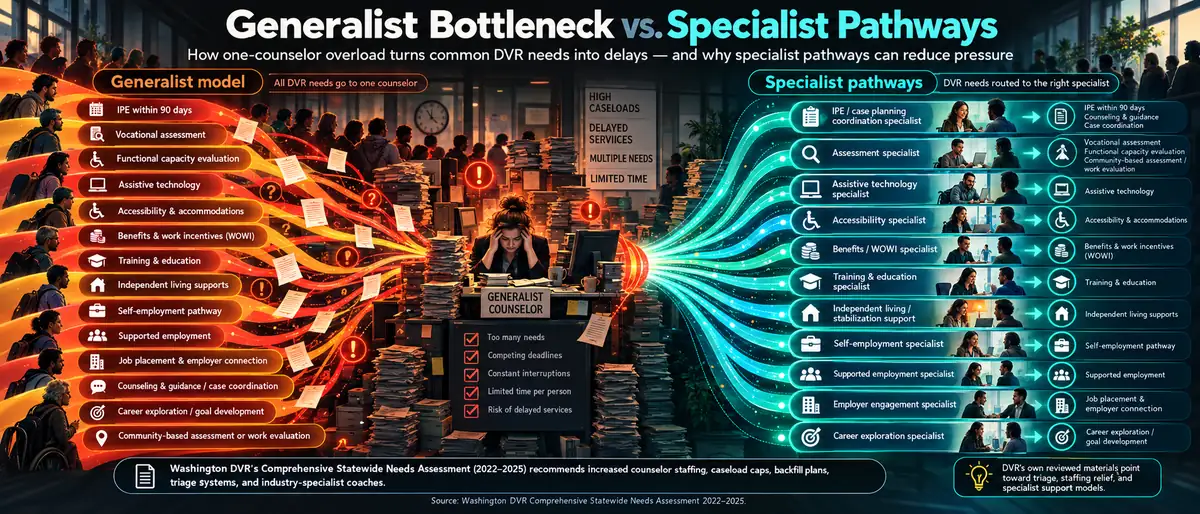
Conceptual systems visualization.
Washington DVR’s
Comprehensive Statewide Needs Assessment 2022–2025
recommends increased counselor staffing, caseload caps, backfill plans, triage systems,
and consideration of industry-specialist coaches. The specialist pathways illustrated
here are a DVR Signal systems-design comparison, not a statement that DVR has formally
adopted this exact staffing architecture.
System status · Issue ranking
DVR Issue Pressure Index
A compact factual view of tracked system issues, current official indicators,
evidence limits, and change over time.
DVR Signal is not publishing a composite pressure score or evaluative ranking at this stage.
The page uses source-backed measurements and preserves source conflicts instead of forcing them
into a single number.
Current snapshot Jul-Dec 2026Source registry v1.0.0Method factual indicators v1.0.0Reviewed 2026-09-27
Snapshot comparison
What changed since the last review?
2026 H1 → 2026 H2
new sourceSource registry
New source in current snapshot: DVR_STATE_PLAN_PAGE_2026
new sourceSource registry
New source in current snapshot: DVR_STATE_PLAN_FINAL_2026
new sourceSource registry
New source in current snapshot: DVR_STATE_PLAN_DRAFT_2026
new sourceSource registry
New source in current snapshot: DVR_CSNA_2025
new sourceSource registry
New source in current snapshot: FED_ECFR_361_36
new sourceSource registry
New source in current snapshot: FED_RSA_VR_PROGRAM
unchangedResource capacity / Order of Selection
5 of 5 priority categories closed — unchanged across the two snapshots
source conflictCounselor workload
Source conflict: 64% current final plan; 40% 2026 draft
new evidenceStaff turnover and continuity
New evidence available: 43.0% of 682 respondents reported one counselor
new evidenceFunding and resource pressure
New evidence available: $27.4M PY2024 case-service expenditures
new evidenceCommunication reliability and service timeliness
New evidence available: 48-hour response standard; interactions documented within 10 days
new evidenceQualified-staff pipeline
New evidence available: 37 VR counselors hired in the prior year
new evidenceAccessibility and accommodation implementation
New evidence available: 93.6% reported access in primary language (n=839)
outcome unavailableAccessibility and accommodation implementation
June 2026 ADA Action Plan target result not located in the current public source set.
The first historical files are retrospective reconstructions created on Sept. 27, 2026.
Future published snapshots are intended to be immutable contemporaneous records.
Current factual signals
Seven tracked issue domains
Participant mode remains unavailable until disclosure-reviewed DVR Signal survey aggregates
are published. Public participant cells must meet the project suppression policy of n ≥
10, with differencing review, and will be labeled
“DVR Signal survey respondents.”
01Resource capacity / Order of SelectionCurrent official sourcePriority categories currently closed5 of 5 categories closed5 of 5 → 5 of 5 → 5 of 5No change across comparable valuesEvidence
What is being measured
Priority categories currently closed
Program capacity and the current use of Order of Selection when DVR reports insufficient resources to serve all eligible participants.
Latest displayed value
5 of 5 categories closed
Measurement period
Current operational status
Comparable trend
No change across comparable values
Supporting indicators
Closure date: Dec. 8, 2025
What remains unknown
The current source set does not provide a current public count of people on the waitlist.
Agency responses or planned improvements
DVR states that participants may be released from the waitlist as resources become available.
Washington State Department of Social and Health Services, Division of Vocational Rehabilitation
Type: official operational status · Effective: 2025-12-08 · Retrieved: 2026-09-27
Pinpoint propositions
Order of Selection status and priority-category tableDVR states that all five priority-of-service categories closed on Dec. 8, 2025; the current table lists Categories 1 through 5 as Closed.
Washington State Department of Social and Health Services, Division of Vocational Rehabilitation
Type: official agency plan · Effective: 2026-07-12 · Retrieved: 2026-09-27
Pinpoint propositions
DSHS/DVR Response to WSRC Item 1 — Counselor Change CommunicationDVR reports that high caseloads and staff turnover harmed clear, timely and consistent communication; it reports float VRC coverage, a 48-hour inquiry response standard, and 30-day automatic email replies after staff departure.
Order of Selection — High staff turnover and vacanciesThe final plan states that 37 new VR counselors were hired in the prior year and that 64% of VRC4 staff manage caseloads above 100 customers.
Order of Selection — Case service spending outpacing available fundingThe plan reports case-service expenditures rising from $17.5 million in PY2021 to $27.4 million in PY2024, nearly 57%, and describes a projected $7.5 million FFY2025 funding gap.
Goal Three, Priority One — Progress MadeThe plan reports IPE timeliness increasing from 75.6% in Q4 PY2023 to 81.2% in Q4 PY2024 and continuing to improve in PY2025.
34 C.F.R. § 361.36Federal regulation governs a State VR agency's order of selection when it cannot serve all eligible individuals.
DVR Signal participant aggregates
No source from this layer is attached to this issue.
A source verifies only the proposition it supports. Agency plans, participant
survey results, federal rules, and future DVR Signal aggregates remain separate.
02Counselor workloadOfficial-source conflictVRC4 staff with caseloads above 10064% in current final plan; 40% in 2026 draft
Comparable trend unavailable.
Comparable trend unavailableEvidence
What is being measured
VRC4 staff with caseloads above 100
Caseload size and staffing capacity affecting case-carrying vocational rehabilitation counselors.
Latest displayed value
64% in current final plan; 40% in 2026 draft
Measurement period
Reporting period not specified consistently
Comparable trend
Comparable trend unavailable
Supporting indicators
Current final State Plan statement: 64% of VRC4 staff manage caseloads above 100
2026 draft State Plan update: 40% of VRC4 staff manage caseloads above 100
What remains unknown
The final plan text does not identify the measurement date for the 64% figure.
A current statewide median, P75, and P90 counselor caseload distribution is not in the source set.
Agency responses or planned improvements
DVR reports additional counselor hiring and use of Order of Selection to reduce caseload pressure.
Washington State Department of Social and Health Services, Division of Vocational Rehabilitation
Type: official agency plan · Effective: 2026-07-12 · Retrieved: 2026-09-27
Pinpoint propositions
DSHS/DVR Response to WSRC Item 1 — Counselor Change CommunicationDVR reports that high caseloads and staff turnover harmed clear, timely and consistent communication; it reports float VRC coverage, a 48-hour inquiry response standard, and 30-day automatic email replies after staff departure.
Order of Selection — High staff turnover and vacanciesThe final plan states that 37 new VR counselors were hired in the prior year and that 64% of VRC4 staff manage caseloads above 100 customers.
Order of Selection — Case service spending outpacing available fundingThe plan reports case-service expenditures rising from $17.5 million in PY2021 to $27.4 million in PY2024, nearly 57%, and describes a projected $7.5 million FFY2025 funding gap.
Goal Three, Priority One — Progress MadeThe plan reports IPE timeliness increasing from 75.6% in Q4 PY2023 to 81.2% in Q4 PY2024 and continuing to improve in PY2025.
Washington State Department of Social and Health Services, Division of Vocational Rehabilitation
Type: official agency draft · Published: 2026-01-01 · Retrieved: 2026-09-27
Pinpoint propositions
p. 67, lines 2540-2543The draft reports that 40% of VRC4 staff manage caseloads above 100 customers.
p. 52, lines 1964-1972The draft reports float VRC coverage, 30-day automatic email replies, documentation of contacts within 10 days, and reinforcement of a 48-hour response standard.
p. 66, lines 2525-2543The draft reports case-service expenditures increasing from $17.5 million in PY2021 to $27.4 million in PY2024 and states that 25 new VR counselor positions were added.
p. 72, lines 2723-2745The draft personnel table reports 52 VRC3 journey staff employed versus 92 currently needed, 63 VRC4 leads employed versus 62 currently needed, and 150 qualified case-carrying counselors serving 10,300 customers as of Dec. 31, 2025, a stated ratio of 69 customers per counselor.
p. 51-52, lines 1946-1972The draft reports IPE timeliness improving from 75.6% in Q4 PY2023 to 81.2% in Q4 PY2024.
Federal / oversight material
No source from this layer is attached to this issue.
DVR Signal participant aggregates
No source from this layer is attached to this issue.
A source verifies only the proposition it supports. Agency plans, participant
survey results, federal rules, and future DVR Signal aggregates remain separate.
03Staff turnover and continuityOfficial research measureRespondents reporting one DVR counselor43.0% of 682 respondents
Comparable trend unavailable.
Comparable trend unavailableEvidence
What is being measured
Respondents reporting one DVR counselor
Continuity of counselor assignment, including the number of counselors participants report having during their DVR experience.
Latest displayed value
43.0% of 682 respondents
Measurement period
CSNA 2022-2025 assessment cycle
Comparable trend
Comparable trend unavailable
Supporting indicators
Number of counselors reported: 1: 43.0%; 2: 26.7%; 3: 15.8%; 4: 5.7%; >4: 6.6%; never: 2.2%
What remains unknown
Counselor count does not establish why a reassignment occurred and is not an administrative turnover rate.
A current statewide vacancy duration and reassignment-duration dataset is not in the public source set.
Agency responses or planned improvements
The CSNA recommends staffing, backfill, triage, and continuity strategies.
DVR reports using float VRCs for cases that cannot immediately transfer to a local counselor.
Washington State Department of Social and Health Services, Division of Vocational Rehabilitation and San Diego State University Interwork Institute
Type: official agency research · Retrieved: 2026-09-27
Pinpoint propositions
p. 19-20, Table 10, lines 698-711Among 682 respondents, 43.0% reported one counselor, 26.7% two, 15.8% three, 5.7% four, 6.6% more than four, and 2.2% never having a DVR counselor.
p. 20, Table 11, lines 712-723Among 664 respondents, 29.5% said reaching their counselor was very easy, 40.2% somewhat easy, 16.4% somewhat difficult, and 13.9% very difficult.
p. 28, lines 1028-1032The CSNA summary says 43% had one counselor, 26.7% had two, and 22% had three or more; this summary does not reconcile cleanly with the Table 10 categories.
p. 55, Table 51, lines 2146-2155Among 839 respondents, 93.6% reported being able to access services in their primary language and 6.4% reported they could not.
p. 8 and p. 32, recommendationsRecommendations include increasing counselor staffing, considering caseload caps and backfill plans, using triage systems, and considering industry-specialist coaches.
Federal / oversight material
No source from this layer is attached to this issue.
DVR Signal participant aggregates
No source from this layer is attached to this issue.
A source verifies only the proposition it supports. Agency plans, participant
survey results, federal rules, and future DVR Signal aggregates remain separate.
04Funding and resource pressureCurrent official sourceCase-service expenditures$27.4M in PY2024, up nearly 57% from $17.5M in PY2021$17.5M → $27.4MLatest comparable value is higherEvidence
What is being measured
Case-service expenditures
Available program resources, reimbursement, service costs, and caseload demand affecting DVR operating capacity.
Latest displayed value
$27.4M in PY2024, up nearly 57% from $17.5M in PY2021
Measurement period
PY2021 to PY2024
Comparable trend
Latest comparable value is higher
Supporting indicators
Projected FFY2025 funding gap: $7.5M
SSA reimbursement change reported by DVR: $3.5M less in 2024
Federal program context: State VR Services is a federal formula-grant program administered by RSA
What remains unknown
Expenditure growth does not by itself establish that federal appropriations fell.
A complete inflation-adjusted resource-per-active-case series has not yet been assembled.
Agency responses or planned improvements
DVR reports cost-containment measures, fiscal monitoring, and use of Order of Selection.
Washington State Department of Social and Health Services, Division of Vocational Rehabilitation
Type: official agency plan · Effective: 2026-07-12 · Retrieved: 2026-09-27
Pinpoint propositions
DSHS/DVR Response to WSRC Item 1 — Counselor Change CommunicationDVR reports that high caseloads and staff turnover harmed clear, timely and consistent communication; it reports float VRC coverage, a 48-hour inquiry response standard, and 30-day automatic email replies after staff departure.
Order of Selection — High staff turnover and vacanciesThe final plan states that 37 new VR counselors were hired in the prior year and that 64% of VRC4 staff manage caseloads above 100 customers.
Order of Selection — Case service spending outpacing available fundingThe plan reports case-service expenditures rising from $17.5 million in PY2021 to $27.4 million in PY2024, nearly 57%, and describes a projected $7.5 million FFY2025 funding gap.
Goal Three, Priority One — Progress MadeThe plan reports IPE timeliness increasing from 75.6% in Q4 PY2023 to 81.2% in Q4 PY2024 and continuing to improve in PY2025.
Washington State Department of Social and Health Services, Division of Vocational Rehabilitation
Type: official agency draft · Published: 2026-01-01 · Retrieved: 2026-09-27
Pinpoint propositions
p. 67, lines 2540-2543The draft reports that 40% of VRC4 staff manage caseloads above 100 customers.
p. 52, lines 1964-1972The draft reports float VRC coverage, 30-day automatic email replies, documentation of contacts within 10 days, and reinforcement of a 48-hour response standard.
p. 66, lines 2525-2543The draft reports case-service expenditures increasing from $17.5 million in PY2021 to $27.4 million in PY2024 and states that 25 new VR counselor positions were added.
p. 72, lines 2723-2745The draft personnel table reports 52 VRC3 journey staff employed versus 92 currently needed, 63 VRC4 leads employed versus 62 currently needed, and 150 qualified case-carrying counselors serving 10,300 customers as of Dec. 31, 2025, a stated ratio of 69 customers per counselor.
p. 51-52, lines 1946-1972The draft reports IPE timeliness improving from 75.6% in Q4 PY2023 to 81.2% in Q4 PY2024.
U.S. Department of Education, Rehabilitation Services Administration
Type: federal program · Retrieved: 2026-09-27
Pinpoint propositions
Program descriptionRSA describes the State VR program as grants to assist States in operating statewide vocational rehabilitation programs.
DVR Signal participant aggregates
No source from this layer is attached to this issue.
A source verifies only the proposition it supports. Agency plans, participant
survey results, federal rules, and future DVR Signal aggregates remain separate.
05Communication reliability and service timelinessCurrent official sourceContact standards reported by DVR48-hour response standard; interactions documented within 10 days54% → 55% → 57% → 59%Latest comparable value is higherEvidence
What is being measured
Contact standards reported by DVR
Participant contact standards, counselor accessibility, transfer communication, and a related customer measure of service timeliness.
Latest displayed value
48-hour response standard; interactions documented within 10 days
Measurement period
2026 State Plan update
Comparable trend
Latest comparable value is higher
Supporting indicators
Ease reaching counselor, CSNA: 29.5% very easy; 40.2% somewhat easy; 16.4% somewhat difficult; 13.9% very difficult (n=664)
Departure continuity measure: 30-day automatic email reply after counselor departure
What remains unknown
No public statewide compliance percentage for the 48-hour response standard is in the source set.
The CSNA reachability measure is cross-sectional and is not the same measure as the response standard.
Agency responses or planned improvements
DVR reports float VRC coverage, automatic replies after departure, and a standardized communication protocol.
Washington State Department of Social and Health Services, Division of Vocational Rehabilitation
Type: official agency plan · Effective: 2026-07-12 · Retrieved: 2026-09-27
Pinpoint propositions
DSHS/DVR Response to WSRC Item 1 — Counselor Change CommunicationDVR reports that high caseloads and staff turnover harmed clear, timely and consistent communication; it reports float VRC coverage, a 48-hour inquiry response standard, and 30-day automatic email replies after staff departure.
Order of Selection — High staff turnover and vacanciesThe final plan states that 37 new VR counselors were hired in the prior year and that 64% of VRC4 staff manage caseloads above 100 customers.
Order of Selection — Case service spending outpacing available fundingThe plan reports case-service expenditures rising from $17.5 million in PY2021 to $27.4 million in PY2024, nearly 57%, and describes a projected $7.5 million FFY2025 funding gap.
Goal Three, Priority One — Progress MadeThe plan reports IPE timeliness increasing from 75.6% in Q4 PY2023 to 81.2% in Q4 PY2024 and continuing to improve in PY2025.
Washington State Department of Social and Health Services, Division of Vocational Rehabilitation
Type: official agency draft · Published: 2026-01-01 · Retrieved: 2026-09-27
Pinpoint propositions
p. 67, lines 2540-2543The draft reports that 40% of VRC4 staff manage caseloads above 100 customers.
p. 52, lines 1964-1972The draft reports float VRC coverage, 30-day automatic email replies, documentation of contacts within 10 days, and reinforcement of a 48-hour response standard.
p. 66, lines 2525-2543The draft reports case-service expenditures increasing from $17.5 million in PY2021 to $27.4 million in PY2024 and states that 25 new VR counselor positions were added.
p. 72, lines 2723-2745The draft personnel table reports 52 VRC3 journey staff employed versus 92 currently needed, 63 VRC4 leads employed versus 62 currently needed, and 150 qualified case-carrying counselors serving 10,300 customers as of Dec. 31, 2025, a stated ratio of 69 customers per counselor.
p. 51-52, lines 1946-1972The draft reports IPE timeliness improving from 75.6% in Q4 PY2023 to 81.2% in Q4 PY2024.
Washington State Department of Social and Health Services, Division of Vocational Rehabilitation and San Diego State University Interwork Institute
Type: official agency research · Retrieved: 2026-09-27
Pinpoint propositions
p. 19-20, Table 10, lines 698-711Among 682 respondents, 43.0% reported one counselor, 26.7% two, 15.8% three, 5.7% four, 6.6% more than four, and 2.2% never having a DVR counselor.
p. 20, Table 11, lines 712-723Among 664 respondents, 29.5% said reaching their counselor was very easy, 40.2% somewhat easy, 16.4% somewhat difficult, and 13.9% very difficult.
p. 28, lines 1028-1032The CSNA summary says 43% had one counselor, 26.7% had two, and 22% had three or more; this summary does not reconcile cleanly with the Table 10 categories.
p. 55, Table 51, lines 2146-2155Among 839 respondents, 93.6% reported being able to access services in their primary language and 6.4% reported they could not.
p. 8 and p. 32, recommendationsRecommendations include increasing counselor staffing, considering caseload caps and backfill plans, using triage systems, and considering industry-specialist coaches.
Federal / oversight material
No source from this layer is attached to this issue.
DVR Signal participant aggregates
No source from this layer is attached to this issue.
A source verifies only the proposition it supports. Agency plans, participant
survey results, federal rules, and future DVR Signal aggregates remain separate.
06Qualified-staff pipelineCurrent official sourceVR counselors hired37 hired in the prior year, according to the current final plan
Comparable trend unavailable.
Comparable trend unavailableEvidence
What is being measured
VR counselors hired
Recruitment, training, vacancy coverage, and the time required for new vocational rehabilitation counselors to carry a full caseload.
Latest displayed value
37 hired in the prior year, according to the current final plan
Measurement period
Prior year as described in the 2026-2028 State Plan
Comparable trend
Comparable trend unavailable
Supporting indicators
2026 draft staffing action: 25 new VR counselor positions added; many reported filled
2026 draft qualified counselor ratio: 150 qualified case-carrying counselors / 10,300 customers = stated 69:1 as of Dec. 31, 2025
Experienced-position pipeline: Open VRC3/VRC4 positions are often initially filled by junior counselors; new VRCs require months of training
What remains unknown
A current public statewide vacancy rate and median vacancy duration are not in the source set.
The final plan and draft describe staffing actions using different measures, so they are not combined into one trend.
Agency responses or planned improvements
DVR's State Plan calls for recruitment and retention strategies and caseload/fiscal forecasting.
Washington State Department of Social and Health Services, Division of Vocational Rehabilitation
Type: official agency plan · Effective: 2026-07-12 · Retrieved: 2026-09-27
Pinpoint propositions
DSHS/DVR Response to WSRC Item 1 — Counselor Change CommunicationDVR reports that high caseloads and staff turnover harmed clear, timely and consistent communication; it reports float VRC coverage, a 48-hour inquiry response standard, and 30-day automatic email replies after staff departure.
Order of Selection — High staff turnover and vacanciesThe final plan states that 37 new VR counselors were hired in the prior year and that 64% of VRC4 staff manage caseloads above 100 customers.
Order of Selection — Case service spending outpacing available fundingThe plan reports case-service expenditures rising from $17.5 million in PY2021 to $27.4 million in PY2024, nearly 57%, and describes a projected $7.5 million FFY2025 funding gap.
Goal Three, Priority One — Progress MadeThe plan reports IPE timeliness increasing from 75.6% in Q4 PY2023 to 81.2% in Q4 PY2024 and continuing to improve in PY2025.
Washington State Department of Social and Health Services, Division of Vocational Rehabilitation
Type: official agency draft · Published: 2026-01-01 · Retrieved: 2026-09-27
Pinpoint propositions
p. 67, lines 2540-2543The draft reports that 40% of VRC4 staff manage caseloads above 100 customers.
p. 52, lines 1964-1972The draft reports float VRC coverage, 30-day automatic email replies, documentation of contacts within 10 days, and reinforcement of a 48-hour response standard.
p. 66, lines 2525-2543The draft reports case-service expenditures increasing from $17.5 million in PY2021 to $27.4 million in PY2024 and states that 25 new VR counselor positions were added.
p. 72, lines 2723-2745The draft personnel table reports 52 VRC3 journey staff employed versus 92 currently needed, 63 VRC4 leads employed versus 62 currently needed, and 150 qualified case-carrying counselors serving 10,300 customers as of Dec. 31, 2025, a stated ratio of 69 customers per counselor.
p. 51-52, lines 1946-1972The draft reports IPE timeliness improving from 75.6% in Q4 PY2023 to 81.2% in Q4 PY2024.
Federal / oversight material
No source from this layer is attached to this issue.
DVR Signal participant aggregates
No source from this layer is attached to this issue.
A source verifies only the proposition it supports. Agency plans, participant
survey results, federal rules, and future DVR Signal aggregates remain separate.
07Accessibility and accommodation implementationOfficial research measureAccess to services in primary language93.6% yes; 6.4% no (n=839)
Comparable trend unavailable.
Comparable trend unavailableEvidence
What is being measured
Access to services in primary language
Observable access measures and implementation of accessibility, language-access, and accommodation improvements.
Latest displayed value
93.6% yes; 6.4% no (n=839)
Measurement period
CSNA 2022-2025 assessment cycle
Comparable trend
Comparable trend unavailable
Supporting indicators
Past ADA Action Plan target: 35% of action items completed + progress on an additional 15% by June 2026
What remains unknown
Primary-language access is one dimension of accessibility and does not measure all accommodation requests or outcomes.
DVR Signal has not located a current public result showing whether the June 2026 ADA Action Plan completion target was met.
Agency responses or planned improvements
The current State Plan calls for enhanced accessibility, accommodations, transportation, and service-delivery options.
Washington State Department of Social and Health Services, Division of Vocational Rehabilitation and San Diego State University Interwork Institute
Type: official agency research · Retrieved: 2026-09-27
Pinpoint propositions
p. 19-20, Table 10, lines 698-711Among 682 respondents, 43.0% reported one counselor, 26.7% two, 15.8% three, 5.7% four, 6.6% more than four, and 2.2% never having a DVR counselor.
p. 20, Table 11, lines 712-723Among 664 respondents, 29.5% said reaching their counselor was very easy, 40.2% somewhat easy, 16.4% somewhat difficult, and 13.9% very difficult.
p. 28, lines 1028-1032The CSNA summary says 43% had one counselor, 26.7% had two, and 22% had three or more; this summary does not reconcile cleanly with the Table 10 categories.
p. 55, Table 51, lines 2146-2155Among 839 respondents, 93.6% reported being able to access services in their primary language and 6.4% reported they could not.
p. 8 and p. 32, recommendationsRecommendations include increasing counselor staffing, considering caseload caps and backfill plans, using triage systems, and considering industry-specialist coaches.
Washington State Department of Social and Health Services
Type: official agency strategy · Retrieved: 2026-09-27
Pinpoint propositions
Strategic Goal 3, Success Measures 3.2-3.4Targets included increasing satisfaction with service timeliness from 58% to 62%, increasing timely IPE completion from 80% to 90%, and completing 35% of ADA Action Plan items plus progress on an additional 15% by June 2026.
Federal / oversight material
No source from this layer is attached to this issue.
DVR Signal participant aggregates
No source from this layer is attached to this issue.
A source verifies only the proposition it supports. Agency plans, participant
survey results, federal rules, and future DVR Signal aggregates remain separate.
Historical snapshots
Preserve what was known at each review
2025 H2Retrospective reconstruction
Order of Selection: all five categories closed by period end.
2026 H1Retrospective reconstruction
All five categories remained the available reconstructed capacity status.
2026 H2Current partial period
Current official indicators, source conflicts, and new CSNA evidence are recorded.
Methods
How to read this page
Measurements, not verdicts
A factual indicator is not a legal finding or an overall evaluation of DVR. The page does
not convert unlike measures into one score.
Trends require comparability
Sparklines appear only when the source provides a comparable series. Otherwise the page
says “Comparable trend unavailable.”
Conflicts stay visible
When official sources disagree, DVR Signal displays the disagreement rather than silently
choosing the more favorable or more critical value.
Participant evidence is separate
Future participant results will describe voluntary DVR Signal survey respondents and will
remain subject to disclosure review and suppression.